


June 2026: Let's talk high-end
We have recently built a pair of 8ft speaker cables for a gentleman from Norway. His first impression upon initial check-out was audible improvement of sound-stage presentation at surprisingly competitive cost. Which had him wondering (if the improvement "really" took place) what else can be changed to have the system perform even better?
A friend, an engineer, is to visit his place later, to see the upgraded system and suggest further step-up-s. Having gone this path myself many times in the past (and from observing others), I compiled a list of suggestions what to upgrade with highest "bang-for-buck". Here's the list:
1. 100m3 room will push room-mode frequencies down,
2. Multiple (12"!) sub-s will improve LF "space-que-s",
3. Speaker selection and placement for correct MF/HF response,
4. Monoblock-s/short-speaker-cables to eliminate cross-talk,
5. Through-and-through balanced/differential topology,
6. Both analogue and digital sources tune-up.
I will expand on each point, but first a few generalities.. We are not chasing "basics" like frequency-response linearity, low and high extension, "speaker-disappearance-act", and such here. These points should be "given" for any system "worth-it's-salt". We are after finer points now, like better soundstage imaging, focus, placement, separation, etc. Years ago Danny RICHIE (reviewing AIRef cable) summarised a bit harshly, but to-the-point: "Not for everybody"..
Number #1: Room gives you the biggest "bang", alas at biggest "buck" too. There is absolutely no substitute (among system upgrades) that match what a large room does to system performance. It makes dealing with room modes much easier, room-mode frequencies are pushed lower. There is less need for "treatment". When used as living-room, spouse will mind a bit less.

Number #3: Speakers (both selection and placement) are the next big-gest item. First thing first - big rooms love big speakers (and vice-versa). Second thing second - "big" sound comes from big speakers. Good stand-mount-s will present a small jazz group credibly, but never a grand concert orchestra. For all the praise Paul McGOWAN has for stand-mount Aspen-s, FR30-s are still his flag-ship..
Number #2: Not even FR30-s are recommended without multiple sub-s. Paul prefers two stacks of two sub-s each. All-in-all four subs per system. Do not use subs with less than 12" diameter, but never larger. Excess moving mass of larger ones impairs bass notes attack and decay. If possible use compression sub-s, but beware: First octave downward extension has to reach at least low-twenties. The-lower-the-better is the chorus here. Cost-wise this is the "land-of-tuned-port" based ones..
Number #4: No matter how good (costly) your stereo power amplifier is, a pair of competent mono-blocks beats-the-s***t-out-of-it. Cross-talk is one of the worst enemies of sound-stage imaging. Unavoidable in stereo amplifiers, not even when the sole common item to left-and-right channels is amplifier enclosure. The single exception being stereo amplifier used in bridge mode as mono-block (you need two identical ones). Mono-block based system opens option for short speaker cables. Use it. The saved cost will almost buy a pair of GaN power amplifiers..
Number #5: Through-and-through balanced system is a world-of-its-own. Take notice of the difference between balanced-in and balanced-out components opposed to full-balanced-ones. Full-balanced (true-balanced) components contain two separate amplification chains for "+" and "-" signals (of each channel), all-in-all four amplification devices internally. Balanced components bring un-shielded balanced interconnect option to-the-table. This is the absolute best of all interconnect species. Except for MC-pickup-to-preamp one. Beware, unshielded MC cartridge cable has to "live" in environment-EM-noise free space!
Number #6: DAC is "the king" here, most-of-all high-DSD (more than DSD64) one. You can stop worrying about "ladder" DAC-s if you prefer DSD to PCM. One thing though, when you play a DSD512 piece, it will not "sing" if the piece was not recorded correctly in the first place. Vinyl based pieces do not match DSD256 ones "in-dreams", but due to smaller vinyl dynamic range available, have to compress recorded-dynamics prior to cutting master. This brings more recorded music above noise-environment-threshold (of the record, and of our listening space). Ergo: There ia a "vinyl-is-better-than-digital" misconception. One hears more recorded sound, true, but not because of vinyl superiority..
June 2026: On fully-balanced, differential MC-cartridge-d vinyl-turntable signal-out-s
Thanks to our good friend Nopakun, and his order of our Ag.n300 conductor based DIN-5-to-single-ended phono-cable (earlier this spring), we were incentivised to do extensive research and experimenting on designing this cable type. Alas, research took place after the cable was already built and delivered to Bangkok. This was giving our chief-designer sleepless nights..

The cable feeds both left-and-right channel-s plus-and-minus-coil-sides (and deck chassis ground), together from Benz-MC-cartridge-d-SAEC-308-tonearm to a single-ended-MC-amp. We had to build the cable so, it plug-s-in to both existing turntable and amp sides as-is. Did not change anything at this stage. The solution starts at the turntable side as a half-balanced (does not separate L-to-R physically), and ends at amp side as single-ended (Cinch).


Due to the length of high-purity silver filament, pure-silver spade-fork, and Coda pure-silver single-point-contact RCA-s used, the cost was considerable. Since this is a non-shielded-not-fully-balanced solution, in hindsight we should have been more concerned about EM environment noise. While a solution like this will perform well for a MM-cartridge-d-tonearm (with it-s higher voltages and currents), MC-a are a different can-of-worms completely. The cable is neutral-and-musical as hell, but relies heavily on the system providing EM noise-free environment externally.
The very first fact, popp-ing-up, at the very start of researching the subject, was availability of high-performance, reasonably-priced, fully-balanced MC-pre-amps of late. Some priced at as low as 400 USD. That has led us to experimenting with fully-balanced signal transfer all-the-way from cartridge pins, to MC-pre input.
Our chief designer kicked-off with skipping the issues we were already certain of: Firstly, the turntable-tonearm has to be head-shell-less to eliminate as many cartridge-to-deck-out connectors (and reduce tip-mass as much) as possible. Secondly, the deck-out baffle has to be as-close-to-tonearm-base as possible to enable soldering tonearm wires straight to deck-out sockets. Thirdly, deck-out-s have to be of good quality, i.e. mini-XLR type.
The final selection fell on an old un-modified (first gen) Pro-Ject RPM-4 deck, cartridged with a Denon DL-103R. It was perfect for development work, everything nut-and-bolt-ed together. Nothing glued whatsoever. That leaves space for pletora of upgrading later, like tonearm, platter, etc. It turned out RPM-4 + 103R + choose-d MC-pre combo had some quirks of it-s own. More on that later.


The first try at cable design was like a shorter-Nopakun-s-cable, but fully-balanced, based on Ag.n100 (single-filament-PTFE-coated) conductor, shield-less, and XLR-ed to fully-balanced, differential, JFET-input MC-pre. A few issues correction later, we got it to hugely outperform previous single-ended tube-based MC-pre. The one issue we could not get rid of completely, was environmental EM noise.

Once the reproduction system is upped to fully-balanced-through-and-through signal-transfer-topology, with competent amplification devices, the performance issues cease to regard linearity, frequency-extension, and such. These are basics no system can miss. Now we deal with other aspects, like detail resolution, phase coherence, soundstage focus, separation, etc. Ambient EM noise induction at cartridge-to-MC-pre stage (although barely audible) wrecks havoc there..
There was no other option save going shielded fully-balanced topology. We are testing a temporary (shielded 2-core Mogami) copper-based cartridge-to-MC-pre cable option, at this time. Waiting for shielded silver-based cable parts order delivery. Performance is already stunning. The massive amount of detail the setup "pulls" out of the vinyl does magic to soundstage. Focusing, positioning, and separation are on the whole new level.
Regretfully, this happens only with records where details were recorded in the first place. And with correct basics like dynamic range, linearity, frequency extension, and such. As Jane Campedelli (Celia - Perfectly Clear) likes to put it: "A good record (man) is hard to find, I always get the other kind". Interestingly enough, while good vinyl-s are few and far apart, are scattered all-over vinyl history.
Some (not all, more in the next paragraph) LP vinyl-s our sound auditors like..
- Sheffield Lab: any Lincoln Mayorga series,
- Reference Recordings: Yerba Buena,
- Clapton: MTV Unplugged,
- InAkustik: Reference Sound Check,
- Stockfisch, etc.
Have not audited all of my vinyl LP-s yet. With DL-103R cartridge-to-Schiit/Skoll combo, static-charge build-up at record-surface-to-needle-tip point wrecks havoc. MC-pre shuts down one or both channels mid-play. The combo performs exceptionally well, but one has to treat the whole vinyl library with clean-ing/anti-static bath, to prevent misconduct. Takes time..
December 2025: On sleeves and other cable design tradeoffs
We were recently asked a question about sleeve choices in AIReference speaker cable build solution. Specifically, would YELLOW use a low-density sleeve braid, if asked to? Where cable innards will be partly visible? Something like this..

This is not a simple choice, and we have already dealt with it more than a year ago, in summer of '24. Therefore we re-examined trade-offs we have made then, again. More on this-time-s conclusion at the end-of-the-chapter, let us put-the-ducks-in-a-row first. What was actually going-on with cable design a year ago? To get-to-the-bottom of this, we have to look a bit farther back still.
AIRef speaker cable design process kicked-off end-of-autumn, late '23. Six-month-ish later we had a working gen.1 build solution. Danny was estimating performance, and providing feedback. Sometime late spring (or early summer) of '24 we had the-ducks-in-a-row. We have finalized the gen.2 AIRef speaker cable build solution, which Danny OK-ed, and later published the notorious "Is Danny Really Going to Recommend $1000 Speaker Cables?" Youtube review.
Which got the AIReference by YELLOW wheels rolling..
Now, going from gen.1, to gen.2, we had to change things. One of these was the sleeve type used. First gen.1 prototypes (SN001/SN002, and a few later ones) were sleeved with low-density PET braid. Actually, not entirely different from the above image..

PET (most times Polyethylene terephthalate, see https://en.wikipedia.org/wiki/Polyethylene_terephthalate) "married" well mechanically to AIRef speaker cable structure. If one handled cables from first, and second picture, with bare hands, eyes closed..
One would be quite hard-put-to-identify one from another.
PET mechanical properties lend themselves well to designing small plastic parts by high pressure/temperature injection moulding. Producing infinite lengths of PET plastic strands, of various diameters, for instance. Which can be wowen into braided sleeves then. So, by varying strand thickness, PET colour, braid density (and any other weaving aspect one can think of), one gets infinite variety of PET sleeve designs.
What we did not like about PET though, was electrical properties. For instance dielectric constant. This parameter value is the main reason we kicked-off the entire AIRef cable project with replacing inter-conductor isolation to air. For better dielectric constant value. Using vacuum (instead of air) would be better still, if we could only do so..
What about other changes from gen.1 to gen.2?
Perpendicular (round) forming members remained. We use Nylon synthetic polymer (see https://en.wikipedia.org/wiki/Nylon). We used as-little-as-possible non-air material. First picture clearly shows member thickness-to-step ratio of 21-ish percent. So: 79% air, 21% plastic. Internal member thickness-along-the-cable is much lower, of course. AIRef cable (in second picture) did not exceed outer ratio. Internal ratio is 1mm-to-25mm-ish (4% nylon, 96% air).
Perpendicular members spring-loaded-ly "clip" into each other in first picture. AIRef members screw together by two M1.2 screws each pair.
All individual conductors twist in same direction in first picture (+ and - ones both). We did not like that. AIRef cable has + conductor set helixing in one direction (chirality), while - set turns opposite.
Conductor make is not known for cable in first image. Gen.2 AIRef cable uses for individual conductor: several various-thickness 8N OCC pure-copper strands lightly twisted together, and protected from surface deterioration by 0.1mm PTFE coat (see https://en.wikipedia.org/wiki/Polytetrafluoroethylene).
Sleeve stuff we have already touched. After discarding PET braid, we looked at many other, including carbon-fibre (see https://en.wikipedia.org/wiki/Carbon_fibers). Eventually, we settled on braided-sleeves woven from glass-fibre bundles (see https://en.wikipedia.org/wiki/Glass_fiber). We liked these for getting electrical properties we wanted, although glass-fibre are not free of other issues. Bundles have to use extremely thin strands, to be flexible, and not break easily.
Connectors eventually became exclusively pure-copper spring-loaded BFA/Z type ones. AIRef cable connectors are cold-crimped to conductors with 80kN hydraulic crimp-jaws.
Conclusion? We have re-examined pro-s and con-s of AIRef speaker cable sleeve tradeoff. When targeting best possible performance, the build solution remains the same. We could use low-density PET braid, instead of glass-fibre one. We are reluctant to do so, for it will be at the expense of cable performance.
June 2025: 6N silver interconnects
The development hve built the first pair of the final solution (the design have had submitted) for a 3ft single-ended all-solid 6N-silver air-helix interconnects. The build solution is based on a 0.35 optimised-cast 6N-silver strand. The conductor build solution packs 3 strands into a 0.1 PTFE tube coat. This results with 0.6-ish equivalent conductor diameter, while keeping the individual strands well below 0.5.

The conductors are threaded through the (somewhat slimmer than in our air-helix speaker cable) support "spine". Helixing slope is at 120 degrees per one "vertebra" member (1 inch-ish distance). The RCA plugs used are solid-silver type. This results with all-silver air-helix cable build, with all the best materials and geometry sifted over from our speaker cable build solutions. As far as we know, this is the first all-silver air-helix interconnect on the market.
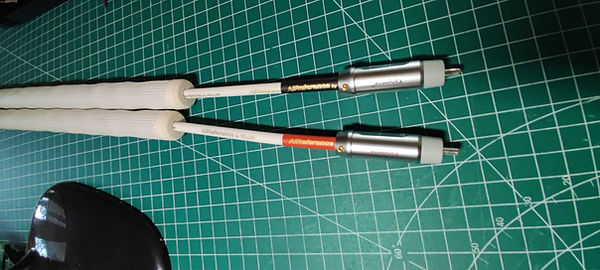
We have spent just a few hours auditioning this build, but the results are (as expected) superb. The cables sit in between a mid-range ESS-based DAC, and an mid-range AR tube preamplifier, in our check-out set-up. The DAC plays hi-res DSD "One-Mic", or "Pure-DSD" recordings almost all-the-time. The build replaced a pair of very good non-air-helix copper interconnects. Imaging, depth, and focus step-up were beyond the slightest doubt, from the first note played on. At first one notices substantially firmer and cleaner low-mid, and high-low ranges, being the most obvious, but then other qualities make themselves aware-of. The sonic background in-between the performers is so extremely silent and black: The first time the performers on one side of the stage (in and around one of the channel mics) stopped playing, the very first thought was the system balance went haywire, or the channel went dead. And then, out of the deep-black, the instruments and voices resurged, clearer than ever before.
These are the highest-echelon contenders, beyond any doubt. And not only performance-wise: following in the steps of our Gen.2 AIReference speaker cables, these aim to be accessible to all, regardless of the bankroll. They will sell at a fraction of the competing products prices.
April 2025: Ballanced interconnect
The development have built the 3ft balanced interconnect cable pair prototype. We will check the sonic performance with several high resolution systems we have access to. Regretfully that takes weeks. Some high end interconnect designers have suggested to burn-in the new cables for 200-ish hours.

There are some other-than-sonic issues with the interconnect prototypes. The glass-fibre braided sleeve the development use (to avoid inferior PET one), is a bit stiff when applied to smaller diameters (than speaker cables). We have to change the sleeve we use here, for a thinner and softer one. The thin/soft of-the-shelf glass-fibre sleeves do not come in black at this time. We will try to build a new all-white-livery prototype instead.
The current connector-design state-of-the-art philosophy is go-as-light-as-you-can. As Mr Colin Chapman (founder of Lotus Cars) used to say years ago: "Just add some lightness", and the performance will follow. That regretfully does not go well with the crop of XLR connectors availlable today. Good looking ones tend to be massive, and more to-the-point - metallic. That is a no-go sonically, of course.
The design are solving this hurdle with alternate XLR connector sources, although it will be hard to equal the good single-ended connector solutions of today. The geometry of the standard-compliant XLR plug simply can not go as-low-mass-as the single-ended one by design. And using the non metallic material is hardly an option.
March 2025: New interconnect product
AIReference by YELLOW development are working on applying the air-helix and OCC-copper build solution to a high-resolution interconnect cable. The very first single-ended, single-conductor, un-shielded cables pair are in the checking-the-prototype-performance phase. The interconnect basic design guideline is down-sizing the speaker cable build solution to smaller, two-to-six conductor build solution.
The prototype single-ended build solution uses a dual-helix conductor space geometry, and single-contact, non-metallic connectors. The next build solution design will be a balanced cable pair with XLR M/F connectors. The balanced cable will use the same conductor spacing support solution as single-ended one, but with triple-helix conductor space geometry.

The AIReference by YELLOW parts inventory have ordered the interconnect cable parts stock. The sales will total the parts, labour, and ROI costs as soon as the shipment clears the import customs, within a week or so. This will give us the interconnect cable sales price.
We continue to strive to offer the audiophile community the very best performance, at a reasonable price.
Regards.. AIRef team